
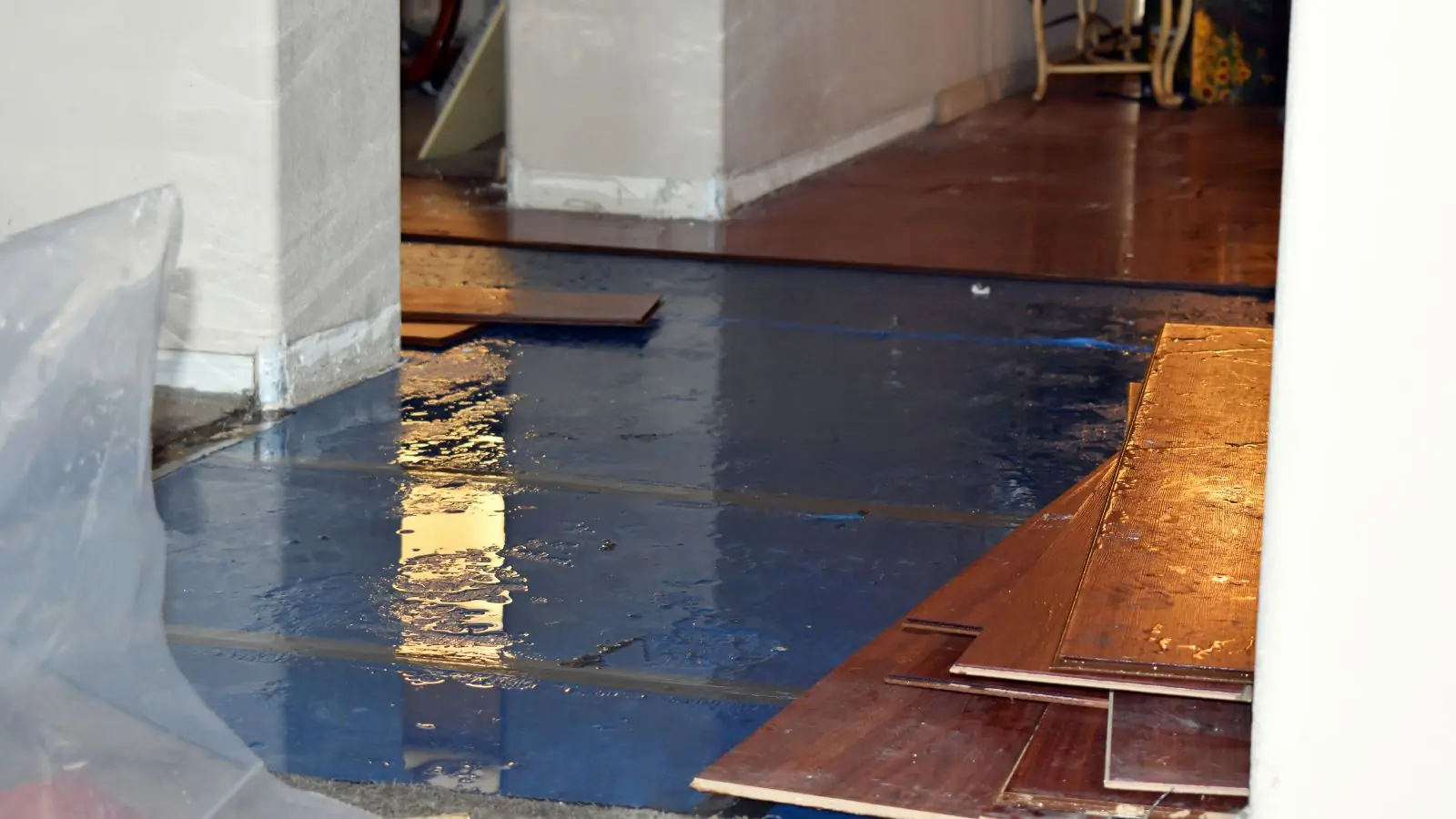
Wood drinks water slowly and gives it back slower
Hardwood absorbs moisture through its edges and underside, then swells. The result may not appear for days, which is why a washer valve that leaked for an hour can still produce curled boards later in the week.
Two sources cause trouble more than any others in homes like these. One is a sudden supply line or valve failure, and the other is a slow leak, such as an air conditioner condensate line that backs up behind a wall and wicks into the floor edge.
Either way, the floor is only part of the picture. The subfloor and the air underneath hold moisture too.
Reading the damage on the boards
Cupping
Board edges rise higher than the center. It usually means moisture is coming from below or the underside is wetter than the top.
Crowning
The center of the board rises above the edges. It can appear after a cupped floor is sanded before it fully dried.
Buckling
Boards lift off the subfloor in a ridge. This is a sign of significant water and often needs board removal.
Gaps and staining
Spaces between planks and dark patches near seams suggest repeated or prolonged wetting.
None of these confirms the whole floor is lost. Moisture readings through the surface and the subfloor guide the decision.
Boards starting to lift?
Call (714) 515-1308 to talk through drying options.
How a wet floor is dried
Drying hardwood is slower and more controlled than drying carpet.
- 1
Stop the source
Shut off the valve, repair the line or clear the drain so no more water arrives.
- 2
Extract
Standing water comes off the surface and any pooled areas with extraction tools.
- 3
Set the equipment
Drying mats pull moisture from boards while air movers and LGR dehumidifiers manage the air.
- 4
Monitor
Readings are taken daily and compared against dry reference wood until levels settle.
- 5
Decide
Boards that flatten can often be refinished. Boards that stay warped are replaced.
Dry it, wait, or replace?
| Condition | Typical path | Why |
|---|---|---|
| Light cupping, caught early | Dry, wait, then reassess | Many floors flatten as moisture equalizes |
| Cupping with a wet subfloor | Dry the subfloor first | Sanding over trapped moisture can cause crowning |
| Buckled boards | Remove affected boards | Boards that lift rarely settle back |
| Prolonged wetting or sewage | Remove and replace | Contaminated wood cannot be cleaned reliably |
| Engineered flooring with delamination | Usually replace | Layers separate once glue lines fail |
Two scenarios that catch people off guard
A washer supply valve can fail while no one is home. The water spreads from the laundry room into the hallway, runs under baseboards and soaks the boards from the edges inward, so the first sign may be a floor that feels slightly spongy near a doorway.
An air conditioner condensate line is slower and sneakier. When it clogs, the pan overflows into a closet or wall and wicks sideways into the flooring over weeks, and the first hint is cupping along one wall.
In both cases a moisture map of the floor, the baseboards and the wall edge shows how far the water went before any boards come up.
Ground moisture and an older housing stock
Fountain Valley's name goes back to a very high water table and artesian wells, and early settlers dug drainage canals so farmland could be worked. That history is a reason to ask an inspector whether moisture is rising through a slab before blaming a single leak.
The 1960s tract homes that replaced the farms are now more than 60 years old. If your hardwood sits over a slab or a raised floor, a technician should measure the subfloor and the air below before anything is sanded or sealed.
Why patience beats a quick sanding
Sanding too soon is one of the most expensive mistakes with a wet floor. It removes material while the wood is still moving, and a surface that looks flat can cup again after the finish is applied.
Our water mitigation crews keep monitoring until readings stabilize. After that, the repair and refinishing stage replaces boards, blends new wood and refinishes with confidence that the base is dry.
Homeowners in Garden Grove and Huntington Beach reach the same dispatch line when a washer or water heater fails.
A common trap
Fans alone rarely dry a hardwood floor. Moving air helps the surface but does little for the subfloor, which is where most of the problem lives.
Frequently Asked Questions
It depends on how wet the floor got, the species, the subfloor and conditions in the room. Monitoring readings daily is the reliable guide, not a calendar.
Many do flatten once they dry slowly and evenly, but some stay warped. Wait for readings to stabilize before deciding on sanding or replacement.
Sudden and accidental water damage is often covered, but gradual leaks often are not. Check your policy and ask your insurer, and keep photos of the source and the damage.
It can be, because water spreads under baseboards and into the subfloor. Check the area with a moisture meter even if the surface feels dry.
It is worth asking, since the city's name reflects a historic high water table. A technician can measure the subfloor and ask whether the moisture comes from a leak or from below.