
First, find out whether you have one
Some Fountain Valley homes sit on concrete slabs, while others have raised floors with a crawl space beneath. Both exist locally, so do not assume. Look for a small access panel in a hallway closet, along the foundation wall outside, or in a garage corner, and check your inspection report or permit records.
If your house is on a slab, the discussion below applies to slab moisture and wall cavities instead, and mold remediation still follows the same removal logic. If you do have a crawl space, treat it as part of the house, not a separate storage area.
Signs the space below needs attention
Musty smell inside
Air from under the floor can rise into rooms, especially near vents and closets.
Soft or cupped flooring
Damp subfloor material swells, warps or softens.
Visible growth on wood
Dark or fuzzy patches on joists, subfloor or sheathing.
Sagging insulation
Wet batts fall away from the floor above and stop doing their job.
Moisture under your home?
Call (714) 515-1308 to talk through what you found.
Where the moisture usually comes from
Plumbing leaks
Supply and drain lines run through the space, and small drips can stay unseen for a long time.
Ground and surface water
Water from irrigation, roof drainage or storm runoff can find its way toward the foundation.
Poor airflow
Closed or blocked vents let humid air sit against wood.
Condensation
Cool ducts and pipes sweat in warm, humid pockets.
What remediation looks like
Crews follow ANSI/IICRC S520, the published standard for mold remediation, and you can ask any company whether its work is based on it.
- 1
Find the source
Moisture mapping and leak tracing come before any removal.
- 2
Contain
Plastic barriers and negative air keep spores from drifting into the living space.
- 3
Remove and clean
Damaged insulation and unsalvageable wood come out, other surfaces get HEPA cleaning.
- 4
Dry
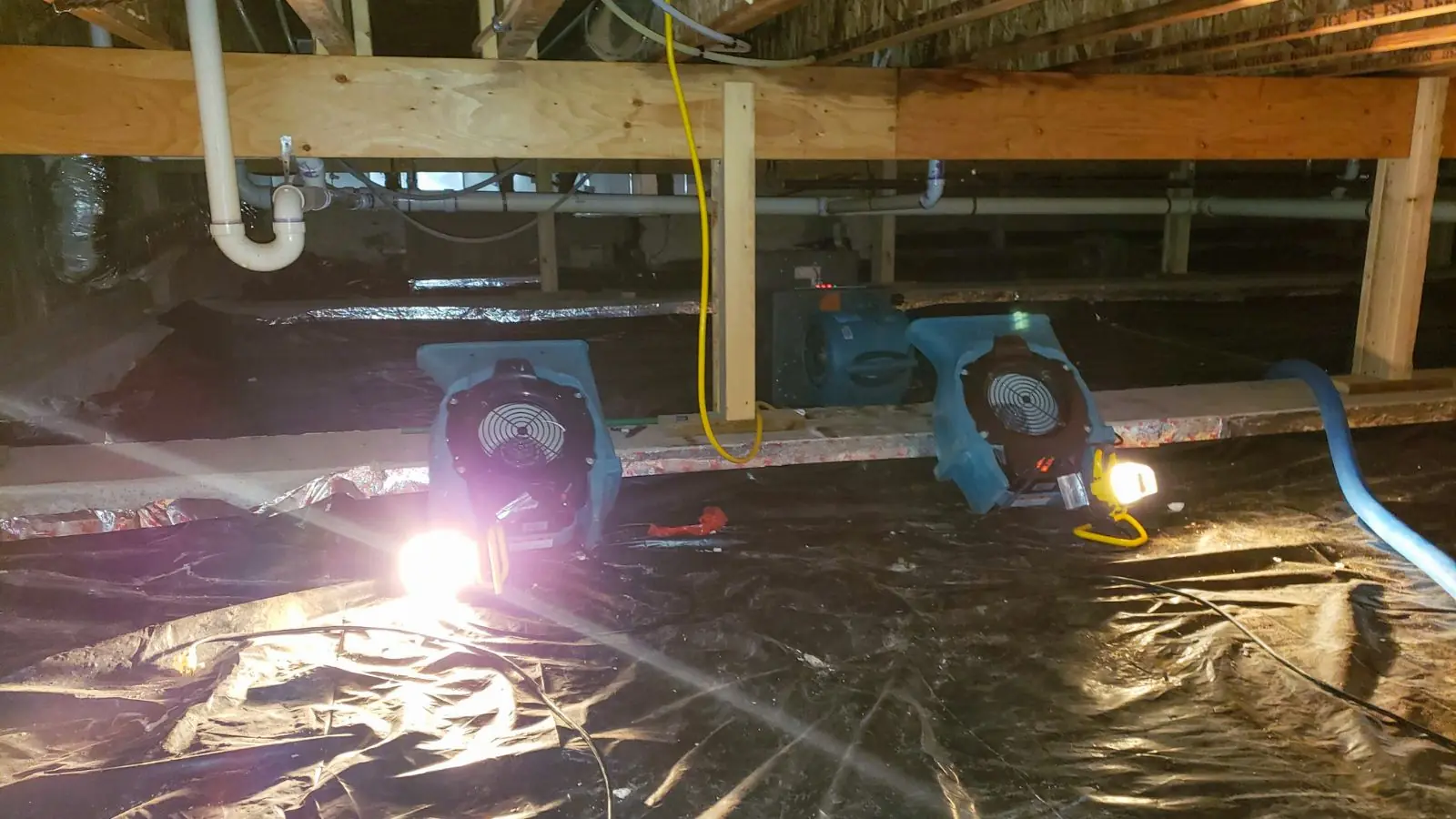
Air movers and dehumidifiers bring materials back to a dry reading.
- 5
Verify
Moisture readings and sometimes independent clearance testing confirm the result.
Drying matters as much as removal
Removing growth without fixing the water source is only a pause. The crew that handles the cleanup should also address how the space got wet, whether that is a pipe repair, grading, or ventilation.
Structures that were wet for a while often need structural drying first, with equipment running for several days and readings taken along the way. Skipping that step leaves damp wood behind for new growth to use.
Homes near the coast side of our service area, such as Huntington Beach, and in Costa Mesa, see the same patterns whenever moisture gets under a raised floor.
Questions to put to any remediation company
- Does your work follow ANSI/IICRC S520, and can you explain how?
- How will you contain the work area and protect the living space?
- How will the moisture source be found and addressed?
- What will be removed, and what will be cleaned and kept?
- How is the area dried and verified afterward?
- Will independent clearance testing be an option?
What to do before the crew arrives
Keep the access panel closed unless you need to look, so air from below does not travel through the house. Do not run fans in the space, since moving air can spread spores to other areas.
If you suspect a plumbing leak, shut off the water to the house and take photos of anything you see. Note when the smell started and whether it changes after rain or irrigation.
Finally, gather anything that shows the home's history, such as past inspection reports or plumbing repair invoices. They help a crew understand what has already been fixed and what has not.
Why ground moisture is worth a thought in Fountain Valley
The city's name goes back to a very high water table and many artesian wells when it was named, and early settlers dug drainage canals to make the land farmable. The settlement of Talbert formed around peat and swampland. That history does not tell you what is under your house today, but it is a good reason to ask an inspector about drainage rather than assume the ground is dry.
OC Public Works calls the Santa Ana River the county's primary flood threat, and notes that some areas outside the river's 100-year zone can still flood where storm drains and channels lack capacity. Check the FEMA flood map for your address, and ask the county or the city about nearby drainage.
Sources: OC Public Works local flood page
Frequently Asked Questions
Not every home has a crawl space, so it is only an issue for raised-floor houses. Where one exists, a plumbing leak or poor ventilation can set up conditions for growth.
Sealing does not remove existing growth or fix a leak. Remediation and moisture control come first, and any sealing or encapsulation comes after.
Not always. Visible growth and a moisture source are often enough to start, while independent clearance testing afterward can confirm the work.
Tight spaces, electrical lines and wet surfaces add risk. A short look with a flashlight from the access panel is reasonable, but ask a professional to go further.
The history is real, but it does not give a reading for your lot. Ask a home inspector about drainage and check the FEMA flood map for your address.