
The Water's Source Decides the Outcome
Picture a washing machine hose that let go while you were out. The carpet is soaked, the pad underneath is soaked, and the question is whether either can be saved. The answer starts with where the water came from.
Industry practice, set out in ANSI/IICRC S500, sorts water into three categories. Clean supply water is Category 1, water with significant contamination is Category 2, and water that carries sewage or floodwater is Category 3.
Water Categories and What Happens to Carpet
| Category | Typical source | Carpet | Pad |
|---|---|---|---|
| 1 | Broken supply line, tub overflow with clean water | Often dried in place | Sometimes saved, often replaced |
| 2 | Dishwasher or washing machine discharge, sump overflow | Cleaned and dried, or replaced depending on time | Usually replaced |
| 3 | Sewage backup, rising floodwater | Removed and discarded | Removed and discarded |
Category can worsen with time. Clean water left sitting can be treated as more contaminated.
Hours matter. The longer carpet and pad stay wet, the more likely they move up a category or start to smell.
Carpet Soaked Through?
Call (714) 515-1308 and say where the water came from.
How Drying Actually Works
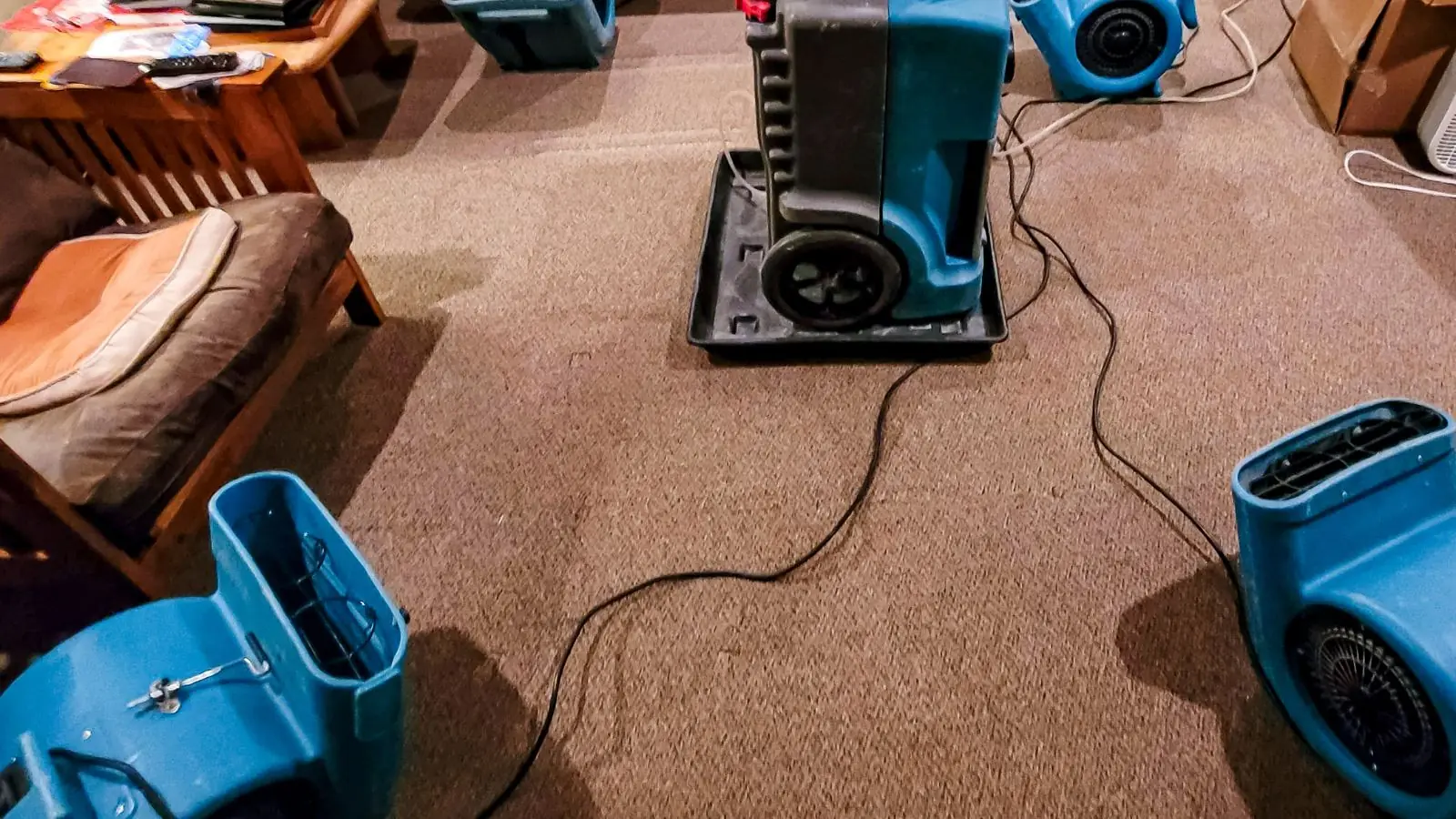
Drying is an equipment job, not a waiting game. Fans alone often leave moisture trapped in the pad and the subfloor.
- 1
Extract
Truck-mounted or portable extraction units pull out as much standing and absorbed water as possible.
- 2
Lift and separate
The carpet is peeled back so the pad can be removed and air can reach the floor.
- 3
Air and dehumidify
Air movers push dry air across the surface and LGR dehumidifiers pull moisture out of the room.
- 4
Verify
Moisture meters check carpet, tack strip and subfloor against dry readings before equipment leaves.
Our [[water mitigation]] crews follow this sequence, and the [[water damage cleanup]] page covers sanitizing and odor work after the drying is done.
Sewage Backup Is a Different Situation
Category 3 safety rules
Keep people and pets out of the room, do not run a household vacuum and do not try to dry the carpet yourself. Contaminated carpet and pad are removed, bagged and replaced, and hard surfaces are cleaned and sanitized.
If power outlets or the panel are near the water, stay out and call the utility or 911 about any electrical risk before you call us.
Who Maintains the Sewer Line? Check Before You Pay
Wastewater from Orange County cities is treated by the Orange County Sanitation District after it leaves city systems. Responsibility for the pipe between your house and the street varies by city. Garden Grove states that property owners maintain, repair and clean the lateral from home to public sewer, while Santa Ana states that it is not responsible for maintaining the roughly 46,000 private laterals in the city.
Fountain Valley's rule was not confirmed for this article, so ask City of Fountain Valley Public Works whether a blockage sits in the public main or your private lateral. The city's history adds a reason to ask: its name traces back to a very high water table, and early settlers dug drainage canals to farm the land.
Sources: Garden Grove sewer services, Santa Ana sewer services, Fountain Valley history
What You Can Do Before the Crew Arrives
Safe first steps for a wet room
- Stop the water at its source and shut off the main valve if you cannot find it
- Lift furniture legs onto foil or plastic blocks so finish and stain do not transfer
- Remove rugs, books, shoes and anything else that can come off the floor
- Open windows and run the air conditioner only if the water was clean and the room is safe
- Photograph the room, the source and any damaged belongings
- Stay out of the room if the water might be contaminated or near electrical outlets
Do not pull up carpet yourself unless you were told it is a small clean-water spill. Peeling it incorrectly can tear the backing and make saving it harder.
When Carpet Is Worth Saving
Carpet from a Category 1 event that is extracted quickly often dries in place, particularly synthetic carpet over a good pad. Replacement tends to win when the carpet is old, the backing has delaminated, or the pad has soaked up contaminants.
Crews serve homes across [[Costa Mesa]] and [[Garden Grove]] with the same drying equipment, so the decision rests on the water and the clock, not the zip code. Photograph the room before anything moves, and keep the pad samples if your insurer asks.
Frequently Asked Questions
There is no single clock. Clean water caught early often dries in place, while contaminated water or several days of wetness points toward replacement. Call right away and describe the source.
For a small Category 1 spill, a wet vacuum helps. A soaked room needs more than fans, because the pad and subfloor stay wet. Moisture readings show whether it is truly dry.
Pad is a sponge that is hard to clean and slow to dry under carpet. Replacing it is often cheaper and safer than leaving it in place.
Keep everyone out, stop using the affected drains and call the 24/7 line. Contaminated carpet is removed, so avoid walking on it or trying to clean it.
The Orange County Sanitation District treats wastewater after it leaves city systems. Ask City of Fountain Valley Public Works about the line serving your home.